Some say simplistically that the Civil War was
fought over slavery. Unfortunately, there is no "simple" reason. The causes
of the war were a complex series of events, including slavery, that began
long before the first shot was fired. Competing nationalisms, political
turmoil, the definition of freedom, the preservation of the Union, the fate
of slavery and the structure of our society and economy could all be listed
as significant contributing factors in America's bloodiest conflict.
Complaints of Georgians
Many of the problems Georgians saw more than one
hundred fifty years ago are being reiterated today. The "oppressive" federal
government. High taxes(tariffs before the war). A growing government
unwilling to listen to law abiding citizens. Sound familiar? They were
complaints levied from 1816 on in Georgia.
Constitutional Questions
People argued about the meaning of the Constitution
since its infancy. From a legal standpoint, the document defines the
relationship between the people of the United States and the federal
government, detailing the powers and responsibilities of each. In 1828
Vice-president John C. Calhoun said if a state
felt a federal law extended beyond the Constitutional rights of the
government that state had the right to ignore(or "nullify") the law. This
concept dated back the Articles of Confederation. President
Andrew Jackson felt the federal government was
the highest authority(Article VI, Section 2) and the states had to abide by
its law.
Tariffs and the Nullification
Crisis
As industry in the North expanded it looked towards
southern markets, rich with cash from the lucrative agricultural business,
to buy the North's manufactured goods. However, it was often cheaper for the
South to purchase the goods abroad. In order to "protect" the northern
industries Jackson slapped a tariff on many of the imported goods that could
be manufactured in the North. When South Carolina passed the
Ordinance of Nullification in November 1832,
refusing to collect the tariff and threatening to withdraw from the Union,
Jackson ordered federal troops to Charleston. A secession crisis was averted
when Congress revised the Tariff of Abominations
in February 1833.
The rhetoric changes
However, the political climate changed during this "Nullification
Crisis." Designations of States Rightist,
Pro-Union, loose
or strict constructionalist became more
important than Whig or Democrat. In North Georgia when John Thomas, a local
politician, was asked what to name a new county he said, "Name it Union, for
none but Union-like men live here." Most of the northern tier of Georgia
counties remained pro-Union until the outbreak of war almost 30 years later.
From this point on factional politics would play an increasing part in the
division of a country.
Economic changes affect society
The Panic of 1837 and
the ensuing depression began to gnaw like a hungry animal on the flesh of
the American system. The disparity between northern and southern economies
was exacerbated. Before and after the depression the economy of the South
prospered. Southern cotton sold abroad totaled 57% of all American exports
before the war. The Panic of 1857 devastated
the North and left the South virtually untouched. The clash of a wealthy,
agricultural South and a poorer, industrial North was intensified by
abolitionists who were not above using class struggle to further their
cause.
The breakdown of the political
system
The ugliness of the political process quickly began
to show as parties turned upon themselves and politics on a national level
were more like local Georgia politics. Feuds and fights in political arenas
were common. From 1837 until 1861 eight men became president, but no man
served more than a single term in office. One sitting president was not
renominated by his own party and another withdrew his name after being
nominated. New political parties were created with names like
Constitutional Union,
American, Free-Soilers and
Republican. In Georgia,
Democrats were strong, but factional fighting broke the party along
pro-Union and States
Rights lines.
With the disintegration of the
Whig party in the early 1850's the political turmoil increased.
Howell Cobb, former Speaker of the House,
molded pro-Union Democrats, mostly from North Georgia, with former Whigs to
grab the governorship in 1851. His attempts to help slaves fell on the deaf
ears of our state legislature. Although Georgia began to prosper during his
first year the coalition fell apart as the Democrats reunited. The
increasing power of the West and self-serving politicians like Stephen A.
Douglas churned the political environment as the North and South battled for
philosophic control.
By the time Buchanan
was elected(1856) the country was divided on many issues, including slavery.
Former Governor Cobb spoke in the North as a moderate Southerner for
Buchanan and served on his cabinet. Over the next 4 years Cobb changed from
pro-Union to secessionist. A similar process occurred across much of
Georgia. In 1860 the state was equally divided between secessionist and
pro-Union.
A concise history of slavery
At Jamestown, Va. in
1611 a group of Scottish women and children were sold as slaves. 7 years
later in Jamestown the first Africans were sold in slavery. From 1611 until
1865 people from virtually every society on earth were sold into slavery in
North America. Citizens in each of the thirteen colonies enslaved people,
but slavery was viewed as a southern institution after the early 1800's.
Along the coastal areas of the South a majority of the slaves were black. In
some inland areas whites and Native Americans outnumbered black slaves.
Slavery is still legal in the United States as a criminal punishment, but is
not practiced.
In 1789 Georgians, as did much of the rest of the
country, saw slavery as a dying institution. Eli
Whitney's stolen modification of the cotton gin(1793) created a
greater demand for slaves, so rather than "wither on the vine" the
institution prospered. The Northwest Ordinance,
adopted in 1787 banned the practice in the Northwest
Territories. In 1798 Georgia forbid further importation of slaves and
the Constitution allowed Congress to outlaw
importation of slaves in 1808, which they did. Over the next 40 years lesser
skirmishes were fought over slavery including the Compromise of 1820. In
North Georgia slavery was not widespread and a majority of the slaves were
of Native American, Scottish or Irish descent.
Slaves often spoke of "our cotton" or "our cattle".
The only item they would concede was the master's carriage. Trusted slaves
were permitted to go to town unescorted. Others suffered horribly.
Conditions in northern factories were as bad or worse than those for a
majority of the slaves, but it would be 40 years after the war when they
were properly addressed.
Beginning in the late 1840's the conflict over
slavery began to boil over. The Compromise of 1850 contributed heavily to
the split in Georgia's Democratic Party. On a national scale
David Wilmot, Lloyd
Garrison, and Harriet Beecher Stowe
enflamed the abolitionists. James G. Birney and
Theodore Weld were more effective against
slavery. The Dred Scot decision,
Kansas-Nebraska Act, and harsher
Fugitive Slave Laws gave the South some
redress.
The new Republican Party
became a home to the alienated abolitionists. Although they totaled less
than 3% of the population at large, they formulated the Republican platform
to include the abolition of slavery as a plank. The party then nominated
Abraham Lincoln for president. Few gave him any chance of success, but 3
other candidates split the popular vote and Lincoln
won. Convinced that Lincoln would ruin the South economically, possibly by
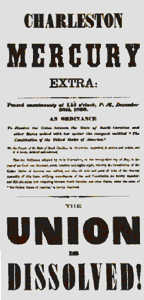
freeing the slaves, the heartland of the South withdrew from the Union.
Shortly thereafter the upper south joined them. The attack on
Fort Sumter launched America's bloodiest
conflict.
So what caused the war?
 The United States
had been moving towards a fractured, divisive society for a number of years.
Cultural and economic differences served to widen the rift. Battles among
North, South, and West grew more heated, especially after 1850. Politicians
and the judiciary sent conflicting signals trying to appease each of the
groups involved, yet all remained dissatisfied. Georgians saw a federal
government controlled by Northern industrialists who were unresponsive to
the problems of their state. Tariffs paid by Georgians bought improvements
in northern and western states. Now the federal government, they thought,
was going to take away personal property without compensation, a clear
violation of their Fourth Amendment rights.
The United States
had been moving towards a fractured, divisive society for a number of years.
Cultural and economic differences served to widen the rift. Battles among
North, South, and West grew more heated, especially after 1850. Politicians
and the judiciary sent conflicting signals trying to appease each of the
groups involved, yet all remained dissatisfied. Georgians saw a federal
government controlled by Northern industrialists who were unresponsive to
the problems of their state. Tariffs paid by Georgians bought improvements
in northern and western states. Now the federal government, they thought,
was going to take away personal property without compensation, a clear
violation of their Fourth Amendment rights.
The South was wrong to assume Lincoln intended to
free the slaves. He had never advocated action to abolish slavery nor did he
speak out against the Illinois rules prohibiting blacks from testifying
against whites. The true abolition candidate, Gerrit Smith of New York drew
few votes. In his inaugural address Lincoln made it clear he would not
interfere with slavery where it existed. Even though he made this speech
after the South seceded he left the door open for their return.
During the war
Southerners abolished the African slave trade in the
Confederate Constitution. In the North "Preserve the Union" was the
battlecry and Lincoln quoted "...a house divided shall not stand..." from
the Bible. In fact the Emancipation Proclamation(1862),
a foreign affair ploy, cost Republicans control of the legislature that
November. A year later Lincoln restated why the war was fought when he said,
dedicating a cemetery at Gettysburg "..for those who here gave their lives
that this nation might live." During the Draft Riots in New York City 88
blacks were lynched.
After the war
Phil Sheridan,
George Armstrong Custer and others adapted very
quickly from killing rebels to the genocide of Native Americans. The South
was "reconstructed" for the next 87 years. Southerners formed "brotherhoods"
that featured white robes, lynchings and unanimous support for Democratic
candidates in the South and West. Confederate General
John B. Gordon, reputed leader of this Ku Klux Klan, was elected
governor of Georgia. Blacks struggled for nearly one hundred years to gain
legal and economic equality.
For a Northern Perspective on why the Civil War was fought, see
Causes of
the Civil War